Research instrument
Dynamic Hazard Rate BART
A full-stack web application administering a redesigned Balloon Analogue Risk Task and a Turkish adaptation of the DOSPERT-30. The data collection pipeline is paired with a scoring engine that analyzes the raw input and produces more than thirty behavioral metrics per session.
- Optimal stop
- √N
- Behavioral metrics
- 30+
- Session length
- < 3 min
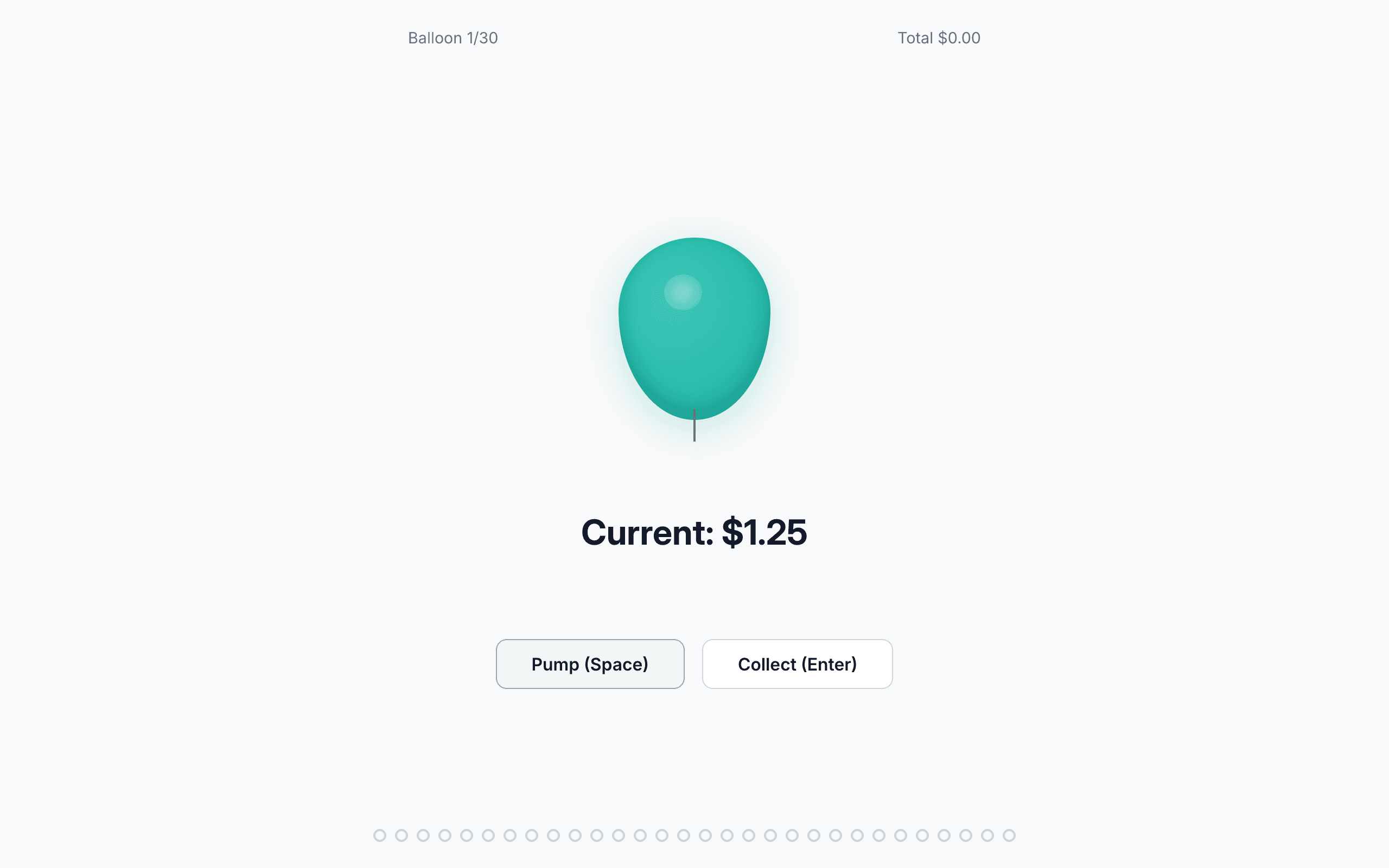
The project centers on a redesign of a standard instrument. In the Balloon Analogue Risk Task (BART; Lejuez et al., 2002), a participant inflates a virtual balloon one pump at a time. Each pump adds a small reward, but the balloon may burst at any moment, and a burst forfeits that balloon’s earnings. Thus the decision is intuitive. Either you keep pumping for a larger reward, or bank what has accumulated.
What the standard task measures, and its limit here
Under its conventional parameterization, the expected-value-optimal strategy is to pump roughly 64 times on the highest-capacity balloon, while participants stop systematically earlier. This gap is not a defect; it is a valid index of risk aversion. The limitation that matters here is narrower. Because the optimum is rarely approached on average, behavioral risk-magnitude and earnings are nearly collinear. So, the task cannot separate calibration from gross exposure. The redesign is therefore an extension of utility measurement to changing environments.
The redesign: a reachable optimum
The central change targets the hazard structure. Instead of a flat baseline burst probability, the probability of bursting rises linearly with each pump, P(burst at pump k) = k/N, where N is the balloon’s maximum capacity.
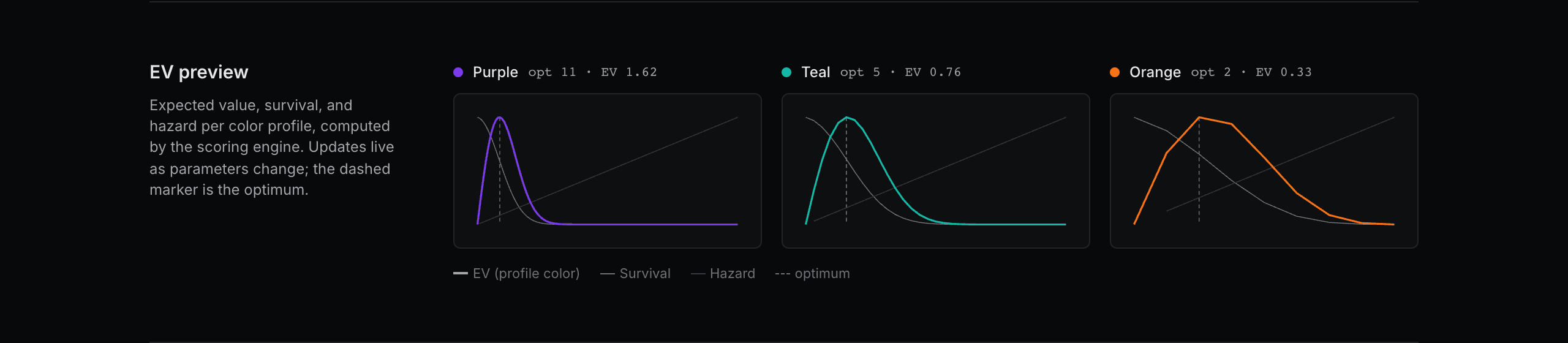
This mechanism’s design is rooted in the concept that risk-taking is not about predicting a fixed future state. Instead, we argue that risk-taking is better modeled as continuous adaptation to new information. Pursuing a larger reward requires pumping further, which raises the per-pump hazard the participant faces. This approach lowers the optimal stopping point from 64 to an attainable value, and a short derivation shows what that value is. Writing the survival probability for reaching pump k without bursting, and approximating it for large N, S(k) = ∏(i=1..k) (1 − i/N) ≈ exp(−Σ(i=1..k) i/N) ≈ exp(−k²/2N), the expected value of stopping at pump k (one reward unit per pump) is E[V(k)] = k S(k) = k exp(−k²/2N). Setting the derivative to zero gives d/dk [k exp(−k²/2N)] = (1 − k²/N) exp(−k²/2N) = 0 ⟹ k* = √N.
The optimal stop is therefore approximately the square root of capacity. The three conditions (N = 128, 32, 8) have discrete optima of 11, 5, and 2 pumps. By normalizing participants’ stopping points against an optimal benchmark, the system categorizes individuals as cautious, calibrated, or risk-seeking. Furthermore, to evaluate behavioral adaptability rather than reliance on a static strategy, the task presents three distinct balloon profiles in a randomized sequence across a thirty-trial session (ten per color). This randomized ordering penalizes invariant decision-making patterns.
Each color corresponds to a different capacity N and hence to a different optimal stopping point:
- Purple: N = 128, k* ≈ 11, low hazard.
- Teal: N = 32, k* ≈ 5, medium hazard.
- Orange: N = 8, k* ≈ 2, high hazard.
Scoring, and the censoring choice
A scoring engine turns each session into a set of behavioral measures. The behavioral-intention metrics use collected (non-exploded) balloons only. The reason is that on a burst trial the intended stopping point is never observed. The balloon ends the trial before the participant decides to bank, so the burst count right-censors the intention instead of revealing it. Restricting to banked balloons is the standard Lejuez adjusted-score remedy. However, this choice is not free of bias. It discards exactly the trials where the most risk-seeking intentions are most likely to have been cut short, and can attenuate the upper tail. Two points bound the concern. First, the fully observed outcome metrics that carry the central claim, money earned and the explosion rate, are not affected. Second, while previous research suggests that soliciting the intended number of pumps prior to each trial provides a straightforward methodological solution (e.g., the automatic BART; Pleskac et al., 2008), we argue that this pre-commitment eliminates the continuous, dynamic calibration inherent to a sequential task. To compensate for this while preserving the task’s dynamic nature, we instead compute alternative behavioral measures, such as post-explosion sensitivity and the explosion penalty.
Principal behavioral metrics produced by the open-source scoring engine, with ranges and a brief interpretation:
ev_ratio_score(0–100). Share of the maximum possible expected value the participant captured; 100 indicates value-maximizing stopping.explosion_penalty(0–1). Excess burst rate relative to optimal play; higher values indicate more over-pumping.rng_normalized_pumps(≥ 0). Average stopping point relative to the optimum; 1.0 is optimal, below 1 is conservative, above 1 is over-pumping.impulsivity_index(0–1). Response-speed measure derived from pump latency; faster pumping yields higher values.tercile_learning_rate(−1 to 1). First-third versus last-third improvement; captures participants who learn late.color_discrimination(≈ −1 to 1). Whether the participant distinguished low-risk from high-risk balloons across the session.post_explosion_sensitivity(≈ −2 to 2). Change in pumping after a burst on the same color; positive indicates an adaptive response to feedback.money_efficiency(0–2). Money collected relative to the simulated median at optimal play; 1.0 is typical optimal earnings.flat_strategy(Boolean). Flags undifferentiated pumping that ignores the balloon’s risk level.behavioral_profile(label). Narrative risk-style classification (for example, cautious, calibrated, or over-exposed) with dominant traits.
The platform
A substantial part of the project was building the platform that supports this design. Rather than adapting existing software, the whole system was built from the ground up as a full-stack web application, available at bart.aselimyilmaz.com. It runs the task in the browser, administers the DOSPERT-30 in a Turkish adaptation, and records event-level data with precise timestamps. Processing the raw event data yields more than thirty computational metrics per participant. To protect against poor-quality data, an automated screening pipeline reviews each session for signs of bot interference or low effort, immediately flagging records that are abnormally fast or incomplete.
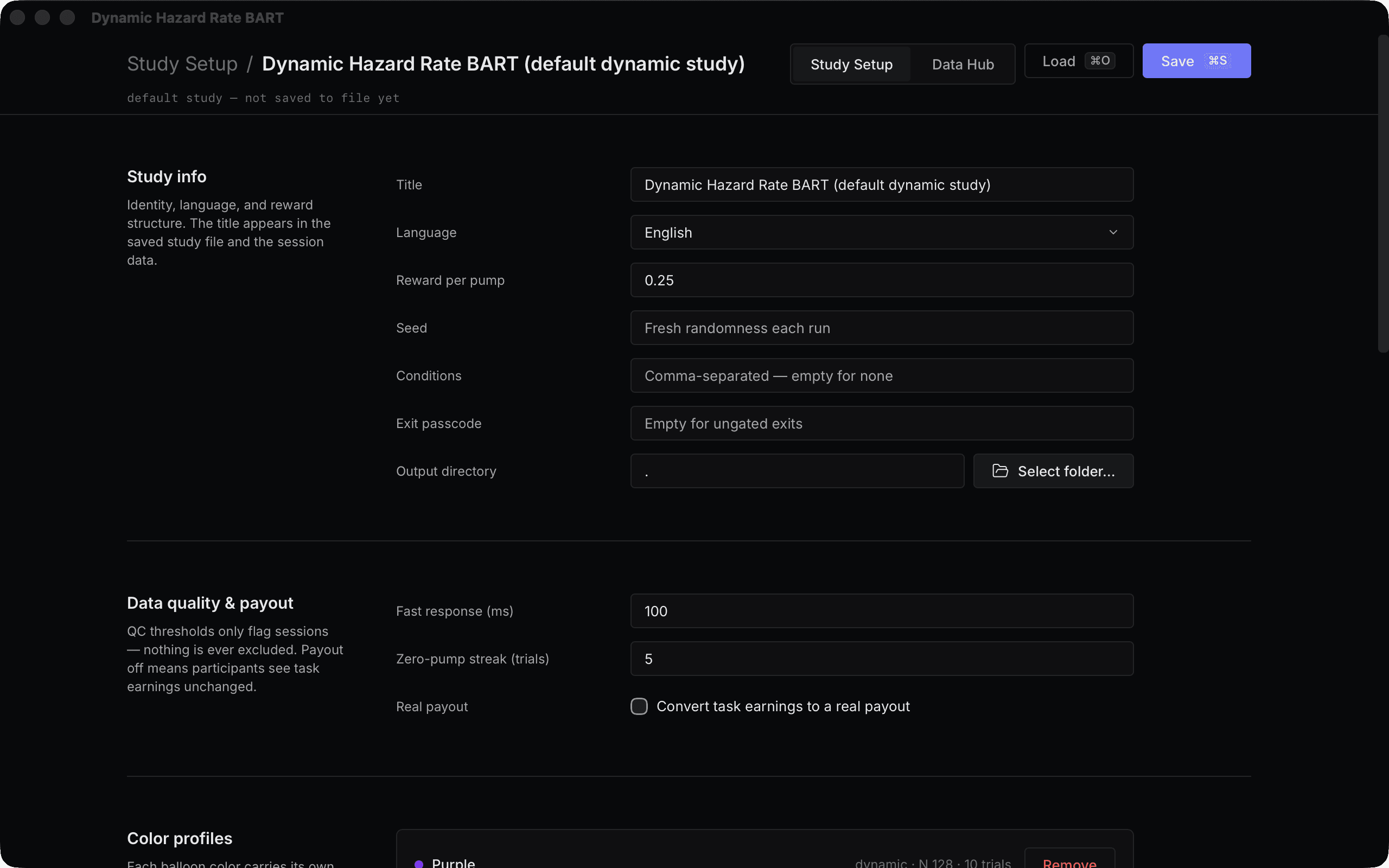
The game client and the scoring engine are released under the MIT license on GitHub and archived on Zenodo with a citable DOI (10.5281/zenodo.20592164). The outcome is a fully functional, reusable platform that researchers can adopt without recreating the underlying architecture. To further enhance accessibility, a future version could ship this tool as a standalone executable. This aims to allow researchers without coding backgrounds to easily deploy the task and adjust key parameters, such as hazard rates, directly within the software.
A second use case: neuroimaging
While the BART is widely adapted for fMRI and EEG environments, the classic mechanism forces participants to execute dozens of physical actions per trial (Compagne et al., 2023). Two distinct features of our present design can be leveraged for this process. First, because the optimal stopping point is mathematically bounded at √N, task performance requires fewer pumps to deploy an optimal strategy. This limits motor load while still separating calibration from aggregate risk propensity. Second, a full session runs in less than three minutes on average, fitting within the reported neuroimaging time budgets.